9 Best Blenders for Making Nut Butter (November 2026)
The best blenders for homemade nut butter include the Turelar Immersion Blender Corded 400W for small jars and deep containers, the Ganiza Smoothie Blender for grinding nuts before blending, and the Hamilton Beach Power Elite Blender For Smoothies for glass jar durability.
On this page (5 sections)
The best blender for making nut butter for most kitchens is the Turelar Immersion Blender Corded 400W, because its long stainless shaft reaches into deep jars and narrow containers where thick paste would otherwise sit still. For large countertop batches, the Aeitto's 68 oz jar and the ASTRALSHIP's Nut Milk preset are the picks to weigh.
Nut butter is a hard test for any blender: the paste gets dense, climbs the walls and stops moving. A stick blender you can move through the jar, or a full-size pitcher with a tamper and enough power, gets the job done with less stopping and scraping.
A narrow jar keeps the nuts close to the blades, while a wide pitcher leaves a ring of paste on the walls that has to be pushed back down by hand. That single detail shapes most of the advice below.
If you also blend frozen fruit and ice, our guide to the best blender for frozen fruit covers models built for that job. For thicker spoonable mixes, see the best blender for smoothie bowls.
Our picks at a glance
-
1
 Best for small jars and deep containers
Turelar Immersion Blender Corded 400W
9.7/10 our score
See it on Amazon -
2

-
3
 Best for glass jar durability
Hamilton Beach Power Elite Blender For Smoothies
9.3/10 our score
See it on Amazon
- 4
 Check it
Colarlemo 1200W Smoothie Blender
Best for grinding nuts in batches - 5
 Check it
ASTRALSHIP Smoothie & Glass Blender for Kitchen
Best for nut milk and cooked nut bases - 6
 Check it
Aeitto Blenders for Kitchen with 68Oz. Jar
Best for large family batches - 7
 Best for pulse control on thick pasteCheck it
- 8
 Check it
Ninja Detect Power Blender Pro TB201
Best for hands-off speed changes - 9
 Check it
Chefman Obliterator 48 oz Blender
Best for cleanup after sticky batches
The best blenders for nut butter at every batch size
The Turelar wins overall because it handles the small, deep jars most people use for nut butter. The rest of the list covers bigger batches, hotter bases and easier cleanup.
Each entry notes who it suits, what its specs mean when nuts are in the jar, and where it gives ground to the models above or below it.
Turelar Immersion Blender Corded 400W: Best for small jars and deep containers
- 400W copper motor
- 2 speeds plus turbo
- Stainless steel shaft
- Blends in any container
The Turelar suits anyone making nut butter a jar at a time. Its slim stainless shaft fits deep pots and narrow containers, so you can move the head through the paste instead of relying on the jar to keep it circulating.
That reach is why it takes the top spot: with nut butter, moving the blades to the paste beats waiting for the paste to come to the blades.
A 400W copper motor drives 2 speeds plus a turbo setting. That is modest power for nuts, so the practical method is short bursts: blend for a few seconds, scrape the sides, repeat.
The maker asks for runs of one minute or less to prevent overheating, and a turbo burst helps when the paste stiffens.
The two-pronged blade design is meant to cut without trapping stem fiber, which also makes the shaft easier to rinse. The 600 ml capacity, non-slip handle and top hanging ring cover the everyday details.
The trade-off is capacity: a family-size jar of peanut butter takes patience. It also cannot crush ice for a frozen dessert afterward.
For that, see whether you can you put ice in a blender safely.
Ganiza Smoothie Blender: Best for grinding nuts before blending
- 900W peak power
- 6-blade cross plus 2-blade flat
- Grinding cup included
- BPA-free cups
Ganiza suits buyers who want to grind nuts first and blend them second. Its kit includes a 10 oz grinding cup with a flat 2-blade assembly, so you can break almonds or hazelnuts into a coarse meal before the main blend.
Grinding first shortens the time the main blades spend chewing on whole nuts.
The 900W peak motor and 6-blade cross run at up to 25,000 RPM, and the maker lists nuts and seeds among the foods it handles. A 1.9 liter total capacity across four cups covers small and medium batches.
The set includes a 24 oz portable cup, two 17 oz middle cups and the 10 oz grinding cup, plus to-go lids.
Safety is handled by a lock: the blender only runs when the cup is seated correctly. Four silicone pads keep the base steady when a thick paste starts to shake the machine.
A cooling fan helps heat dissipate during longer jobs. The trade-off against the top pick is access: a closed cup means you stop and unscrew the lid to scrape, while the Turelar lets you work straight down into an open jar.
Our blender for smoothie bowls roundup shows more cup-style options.
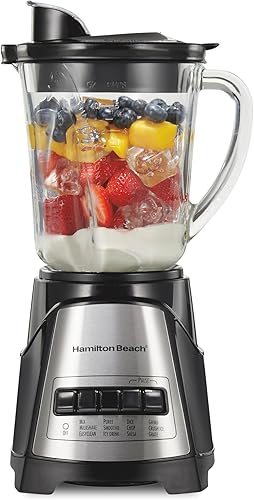
Hamilton Beach Power Elite Blender For Smoothies: Best for glass jar durability
Hamilton Beach suits anyone who wants a sturdy glass jar and simple buttons. The 40 oz glass container resists scratching and staining from oily nut paste better than plastic, and the jar, lid and removable blades are all dishwasher safe.
Glass also lets you see the paste as it turns, which helps you judge when to scrape.
The 700W peak motor and stainless Ice Sabre blades are backed by the Wave Action system, which keeps forcing ingredients down into the blades as you blend. The maker notes that a minimum of one cup of liquid per recipe keeps the blend moving, so add enough liquid before you start.
Twelve functions run from five buttons, and the pour spout helps when you decant butter into a storage jar.
Glass brings weight, and 40 oz is a modest batch size next to the Aeitto. For nuts, the 700W motor needs more pulse-and-scrape breaks than the 1800W machines here.
It suits a household that makes a jar or two at a time and values a glass jar over raw power. For frozen desserts made the same way, see the blender for making ice cream.
Colarlemo 1200W Smoothie Blender: Best for grinding nuts in batches
Colarlemo suits buyers who want to grind nuts in batches without a big countertop pitcher. Two 6-blade assemblies in 304 stainless steel are wider and thicker than standard blades, and the 1200W motor spins to 25,000 RPM.
The blades are built to pull nutrition out of tough ingredients, which is the same property that breaks down nut solids.
The kit includes three cups at 23 oz, 32 oz and 37 oz full capacity, each with clear measurement lines. Two flat lids and a to-go lid mean you can store a batch in the cup you blended it in.
One-touch operation keeps it simple: push and twist to start. The motor has side and bottom vents, and the maker asks for a 10 to 20 minute cooldown if it stops during a hard blend.
Four silicone feet keep the base steady.
The trade-off is control. There is a single speed, so thick nut paste relies on pulse-style starts and plenty of scraping.
It takes less cabinet space than the big pitchers. Choose it if you mostly make small batches and want the cups for storage.
ASTRALSHIP Smoothie & Glass Blender for Kitchen: Best for nut milk and cooked nut bases
- 1500W motor
- 8-blade 304 stainless steel
- 14 presets including Nut Milk
- Glass pitcher with tamper
ASTRALSHIP suits anyone who wants to make nut milk and nut butter in the same machine. The 1500W motor and 8-blade 304 stainless steel assembly are built for dense ingredients, and a custom tamper lets you push food toward the blades with the lid locked.
That combination solves the biggest nut butter problem, which is paste that stops moving.
The 14 presets include Nut Milk, plus soup, sauce and grind programs. Nine manual speeds from P1 to P9 give finer control when a preset is not the right fit.
An 800W heater cooks soups and porridge in the thermal-shock resistant glass pitcher, and a 24-hour delay timer plus a 6-hour keep-warm function suit busy mornings.
For nut butter, the tamper is the real advantage: you can keep the paste moving without stopping to remove the lid. The heat-assisted Auto Clean cycle reaches 158°F to loosen sticky residue.
The trade-off is size and weight. At about 11 lb and 18.7 in tall, it needs cabinet clearance and a firm spot on the counter.
The glass pitcher is heavy to lift when full. It is the strongest pick here for cooked nut bases and large savory batches.
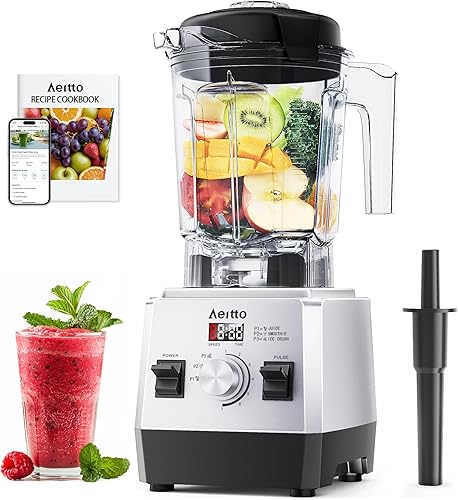
Aeitto Blenders for Kitchen with 68Oz. Jar: Best for large family batches
- 1800W peak power
- 68 oz BPA-free jar
- 3 presets and 7 speeds
- Self-clean mode
Aeitto suits households that make nut butter in family-size batches. The 68 oz BPA-free jar holds up to 6 cups per batch, and the maker lists nut butters among the tasks its 1800W peak motor handles.
That headroom matters when the paste thickens and the motor has to keep pushing.
Three presets cover smoothies, juices and crushed ice, and seven speeds let you switch tasks with precise texture control. An LED panel shows speed, time and program status as you work.
The compact body measures about 16.5 in tall, so it fits under many cabinets.
Cleanup is simple: the one-touch self-clean mode takes about 30 seconds with water and detergent, and all detachable parts except the base and the lip are dishwasher safe. Overheat protection shuts the motor down automatically if it gets too hot.
A plunger and cookbook are included. The trade-off against the Turelar is reach: a wide pitcher leaves more paste on the walls to scrape, though the included plunger works as a tamper to push the paste back down.
Choose the Aeitto if you want one machine for big smoothie batches and large nut butter jars.
OMMO Blender 1800W: Best for pulse control on thick paste
- 1800W motor
- Six-blade 304 stainless steel
- Variable speed and pulse
- 60 oz BPA-free jar
OMMO suits tinkerers who want to adjust speed and pulse by hand while a thick paste comes together. A variable speed dial plus a pulse button gives full control over texture, from silky to chunky.
For nut butter, the pulse option is the useful one, because short jolts break the paste loose without letting the motor run long and hot.
The 1800W motor drives six 304 stainless steel blades in a triple-tiered design, and the 60 oz BPA-free jar holds up to 8 cups. The lid has a handle that opens without spilling, and the jar is dishwasher safe.
The body is designed to fit under most cabinets. A safety lock powers the blender off when the cup leaves the base.
The maker also suggests using a tamper to push food down when it piles up, though a tamper is not listed among the included parts.
The trade-off is that manual control means more attention. You set the speed and watch the paste rather than letting a preset run.
The plastic jar also stains more readily than glass with oily mixes. For fruit-heavy mixes, our blender for frozen fruit picks cover that job.
Ninja Detect Power Blender Pro TB201: Best for hands-off speed changes
- 1800 peak watt motor
- BlendSense auto adjust
- 72 oz pitcher
- Variable speed dial
Ninja suits buyers who want the machine to manage speed changes. BlendSense technology adjusts speed and time automatically, and the dial shows which mode it is in.
Add ingredients, press the dial and let it work. That hands-off loop is the point of this machine.
The 1800 peak watt motor and Total Crushing and Chopping blade assembly are built for tough ingredients. A 72 oz pitcher handles large batches, and one-touch Chop programs process salsa and similar mixes.
A variable speed dial gives manual control in the full-size pitcher. The pitcher, lid and blades are top-rack dishwasher safe.
For nut butter, the hands-off approach is a plus: the blender can ramp up as the paste thickens without you turning a dial. The 72 oz pitcher is the largest here, so a full batch fits with room to spare.
The trade-off is fewer manual levers than the OMMO. If you like fine-tuning speed yourself, BlendSense may feel like it is deciding for you.
The pitcher is also large, so it takes more cabinet space. Choose it for big households that want automation over manual control.
Chefman Obliterator 48 oz Blender: Best for cleanup after sticky batches
- 1380W motor
- 48 oz Tritan jar
- Auto Blend function
- Tamper and scraper included
Chefman suits buyers who dread cleaning up after a sticky batch. The Auto Blend function analyzes ingredients and sets the blend for an even consistency, and the Clean preset runs with soap and water.
Accessories are dishwasher safe. LED alerts also prompt you to fix the jar or add liquid when the blend stalls, which is common with thick nut paste.
The 1380W motor and stainless steel blunt blade design crush ice and handle nuts. A 48 oz Tritan jar resists shattering and allows hot-liquid blending with the lid cover off.
A 2-in-1 tamper and scraper tool is included, which helps push thick paste toward the blades. The lid cover doubles as a 1 oz measuring cup.
The dial panel offers 5 speeds and pulse. Chefman backs it with a 5-year warranty and UL approval.
The trade-off is capacity and score placement. At 48 oz it makes smaller batches than the Aeitto or Ninja, and its score sits at the bottom of this list.
It earns its place for easy cleanup and the included scraper. Pick it if you make modest batches and want less washing afterward.
How these blenders compare for nut butter
| Product | Best for | Power | Speeds | Capacity | Our score |
|---|---|---|---|---|---|
| Turelar Immersion Blender Corded 400W | small jars and deep containers | 400W | 2 plus turbo | 600 ml | 9.7 |
| Ganiza Smoothie Blender | grinding nuts before blending | 900W peak | 1.9 liters | 9.5 | |
| Hamilton Beach Power Elite Blender For Smoothies | glass jar durability | 700W peak | 40 oz | 9.3 | |
| Colarlemo 1200W Smoothie Blender | grinding nuts in batches | 1200W | 9.3 | ||
| ASTRALSHIP Smoothie & Glass Blender for Kitchen | nut milk and cooked nut bases | 1500W | 9.0 | ||
| Aeitto Blenders for Kitchen with 68Oz. Jar | large family batches | 1800W peak | 68 oz | 8.9 | |
| OMMO Blender 1800W | pulse control on thick paste | 1800W | 60 oz | 8.2 | |
| Ninja Detect Power Blender Pro TB201 | hands-off speed changes | 1800 peak watts | 72 oz | 7.7 | |
| Chefman Obliterator 48 oz Blender | cleanup after sticky batches | 1380W | 48 oz | 7.2 |
Our score weighs specs, features and buyer feedback against what you're shopping for. For nut butter, the weight falls on motor power, blade design, jar shape and how easily you can scrape the walls.
Every model here asks for cooldowns on hard jobs. The immersion blender and the smaller cup models show the least wattage, but the immersion design compensates by moving the blade through the food.
A narrow, deep jar keeps paste near the blades; a wide pitcher leaves more on the walls. Between the pitchers, the ones that ship with a tamper or a scraper have an edge, because pushing paste back down is unavoidable once it thickens.
Self-clean modes and dishwasher-safe parts on the Aeitto, Ninja, Chefman and ASTRALSHIP cut the scrub time, while detachable stick blenders rinse fastest of all. Nut butter leaves an oily film, so a machine you can clean quickly is one you will actually use for the next batch.
How we compared these blenders
We compared the models on the specs and features each maker lists: motor wattage, blade count and material, jar size and material, speed and preset options, and cleaning support. We then weighed those against the job of turning nuts into spreadable butter.
Capacity and jar shape carried as much weight as raw wattage, because a powerful motor in a wide jar still leaves paste stuck to the walls.
The scores reflect how well each machine's design fits nut butter: reach into the jar, sustained power, control over texture and cleanup. Buyer ratings informed the ranking but did not replace the spec comparison.
What should you look for in a blender for nut butter?
Look for enough motor power to keep the paste moving and a jar you can scrape easily. A strong motor in a jar you cannot reach into still leaves you scraping by hand, and a reachable jar with a weak motor stalls before the nuts release their oils.
How much power does nut butter need?
Aim for at least 1200W in a countertop blender. Nuts release their oils slowly, and a weaker motor stalls or overheats before the paste turns smooth.
An immersion blender is the exception: its 400W motor works because you move the head through the paste, and turbo mode adds a burst when the paste stiffens.
Which jar shape works best?
A deep, narrow jar or cup keeps the paste close to the blades. Wide pitchers need a tamper or frequent scraping.
The ASTRALSHIP and Chefman both include tampers for this reason. Glass resists staining from oily mixes; plastic is lighter and less likely to shatter.
Tritan, used in the Chefman, sits in between: lighter than glass and more shatter-resistant.
Do presets help with nut butter?
Presets help when they match the job. A Nut Milk program, as on the ASTRALSHIP, gets close to the texture nut butter needs.
A BlendSense dial that adjusts automatically, as on the Ninja, takes some guesswork out. Manual controls give more precision: the OMMO's variable speed and pulse let you slow down when the paste starts to climb.
For a first batch, a simple pulse-and-scrape routine works on any of these machines.
Should you choose a stick blender or a countertop pitcher?
Choose a stick blender for small batches and deep jars. It reaches into containers a pitcher cannot, and you can move it through the paste as it thickens.
Its slim shaft fits most bowls, pots and containers, so you can use the jar you already own. Choose a countertop pitcher for family-size batches: the Aeitto's 68 oz jar and the Ninja's 72 oz pitcher handle bigger loads in one go.
Cup-style machines like the Ganiza and Colarlemo sit in between: small enough to store easily, but closed, so you stop to unscrew the lid.
What about cleaning and storage?
Self-clean modes on the Aeitto and Chefman run water and detergent through the jar. Detachable stick blenders rinse fastest because the shaft comes off; store the shaft upright and keep the motor body dry.
Measure your shelf before buying the tallest pitcher: the ASTRALSHIP needs 19 in of clearance, while the Ninja and Aeitto are shorter but wider.
Can you use a blender for nut milk as well as nut butter?
Yes, with the right model. A machine with a Nut Milk preset, like the ASTRALSHIP, blends soaked nuts and water into milk and can then run a thicker cycle for butter.
Strain the milk first if you want it smooth. For butter, use less or no water so the nuts release their own oils.
Cup blenders handle small batches of nut milk well, but the pulp packs down in the cup, so blend in short bursts and scrape often.
The verdict on the best blender for nut butter
The best blender for making nut butter for most homes is the Turelar Immersion Blender Corded 400W, because it gets into small jars and deep containers and lets you move the blade through thick paste. Pick the Aeitto if you make large batches, the ASTRALSHIP if you want a tamper and nut milk presets, or the Chefman if easy cleanup matters.
For most readers, start with the Turelar and a deep jar. If your household goes through nut butter quickly, step up to the Aeitto's 68 oz jar or the ASTRALSHIP's tamper and 14 presets.
The Ninja suits anyone who would rather let BlendSense pick the speed. Whatever you choose, blend in short bursts and scrape often: that routine gets the best blender for nut butter working its hardest without stressing the motor.
Our top 3 picks at a glance
-
1
Best for small jars and deep containers
Turelar Immersion Blender Corded 400W
9.7/10 our score
See it on Amazon -
2
-
3
Best for glass jar durability
Hamilton Beach Power Elite Blender For Smoothies
9.3/10 our score
See it on Amazon
Frequently asked questions
How long does a blender take to turn nuts into butter?
Plan on several minutes of stop-and-scrape cycles rather than one long run. Hard nuts like almonds take longer than cashews or peanuts.
The Turelar manual asks for runs of one minute or less, so pause often and let the motor cool.
Do I need to add oil to make nut butter in a blender?
Often no oil is needed if you scrape the jar often and let the nuts release their own oils. A small splash of neutral oil can help the first batch move in a lower-power blender.
Add it a teaspoon at a time so the paste does not turn runny.
Can I make nut butter in a single-serve cup blender?
It works for small batches of softer nuts, but the cups are short and the paste packs down around the blades. An immersion blender in a deep jar or a full-size pitcher handles the scraping step more easily.
Keep batches small either way.
Which nuts are easiest to blend into butter?
Cashews, peanuts and pecans break down faster than almonds or hazelnuts. Softer nuts need less motor strain and fewer scrape breaks.
Start with one of those to learn the rhythm, then move to harder nuts once you know your blender's limits.
Should I roast nuts before blending them?
Roasting dries the nuts and warms the oils, which makes the paste release faster. Let them cool for a few minutes so the heat does not stress the motor.
Raw nuts also work but usually need longer blending and more scraping.


